
Exhibition services
Stand Production
Exhibition stand builders who finish on time
How it works
A show opens whether your stand is finished or not. As exhibition stand builders we work to the build-up schedule the organiser sets, and we supervise from first delivery to final dismantle — at venues across the Gulf, Europe and North America.
Exhibition stand construction, workshop to dismantle
01
Workshop
Built and test-assembled
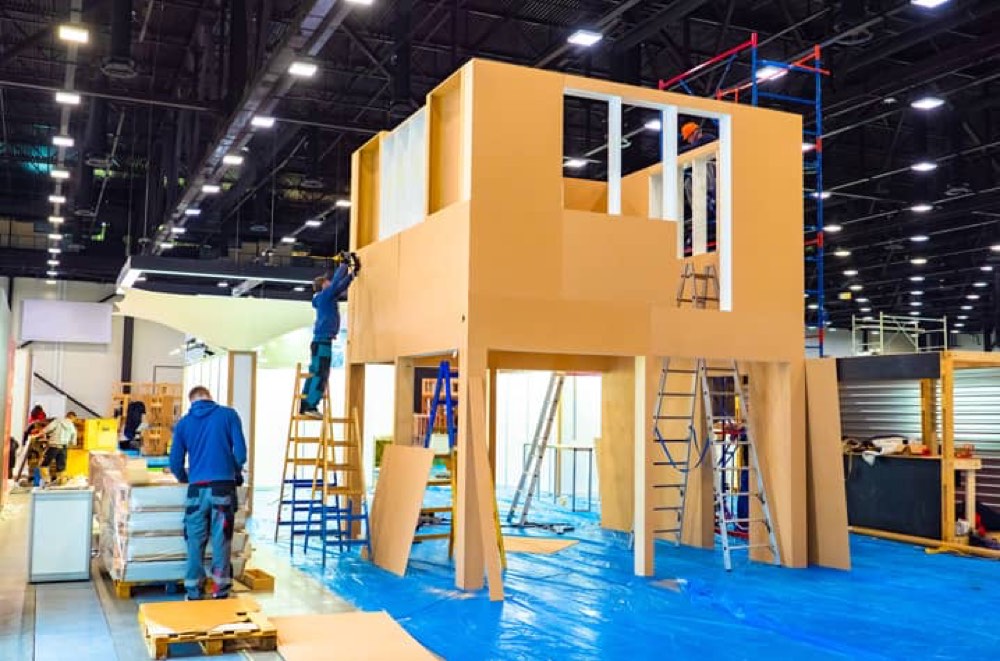
Structures are built and test-assembled before they travel, so problems are found in the workshop rather than on the hall floor at midnight.
02
Build-up
Supervised on site
A supervisor on site through build-up, coordinating electrics, rigging, AV, flooring and graphics, and dealing with the organiser and the venue directly.
03
Show days
Maintained, then dismantled
Daily cleaning, restocking, opening and closing the stand, then a dismantle that returns your assets to store or on to the next show.
What “on time” actually requires
The schedule is the organiser’s, not ours
Every exhibition runs on a build-up schedule the organiser publishes months ahead. It sets when your freight can arrive, which entrance it comes through, when the forklift is available, and the hour by which aisles must be clear. Miss a delivery window and the options are paying for storage or building with fewer hours than the job needs.
So production is scheduled backwards from that window rather than forwards from the day the design is signed off. The workshop date, the freight booking and the crew call are all derived from it. That is the whole discipline, and it is why a late design sign-off costs more than it looks like it should — it does not move the show, it compresses everything between.
Built twice
Why the stand goes up in the workshop first
Structures are assembled in the workshop before they travel. Panels are offered up, the stair is fitted, the graphics are hung, the electrics are run and powered. Then it comes apart, gets numbered and packed.
This is the single most useful thing a production team does, and it is invisible to the client. A panel that is four millimetres out is a ten-minute problem on a workshop floor with the whole rack of offcuts to hand. The same panel is a two-hour problem in a hall at eleven at night, with no materials, no saw, and an aisle that has to be clear by midnight.
It also means the crate arrives labelled in the order it is needed, which is why some stands go up calmly and others involve four people looking for a part.
On site
What a supervisor is actually doing during build-up
The paperwork nobody mentions
Documents the venue will ask for
Most halls will not let a build start without risk assessments and method statements, structural calculations for anything above a set height, rigging plans with point loads, and electrical certification. Double-decks need engineer sign-off. Some venues want proof of insurance and a named site supervisor before they issue passes.
This is dull and it is also where builds fail. A stand that is designed, made and delivered but whose structural drawings were never approved does not go up. We produce and submit these as part of the build, on the organiser’s deadlines rather than ours.
Custom, modular, or built to come back
Three ways to own a stand
A custom build is made for one show and one space. It gives you exactly the stand you designed and it is the most expensive per outing.
A modular system uses a reusable frame with custom graphics and joinery over it. Done badly it looks like a kit. Done properly most visitors cannot tell, and it costs considerably less across a year of shows.
A reconfigurable custom stand is built once to work at several footprints — the same components arranged as a 6×3 at one show and a 9×6 at the next. It costs more up front and less per show from the second outing, and it needs to be designed that way from the beginning. It cannot be retrofitted.
Which one is right depends on how many shows you do a year and how much they vary in size. We will ask that before recommending anything.
After the doors close
Dismantle is part of the job
Dismantle runs on a schedule as tight as build-up, usually starting the hour the show closes and often overnight. Assets are dismantled, packed against the same numbering they arrived with, and either returned to store or shipped to the next show.
Anything left in the hall past the deadline is removed by the venue and charged to you, so the stand that gets packed properly is the stand that is still usable next year. Storage between shows, and an inventory of what you own and what condition it is in, is part of what we hold for you.
What stand production covers
Part of exhibition management
The organiser sets the build-up schedule. We work backwards from it.
- Workshop fabrication and test build
- Transport to the venue
- Build-up supervision on site
- Electrical and rigging coordination
- Graphics and AV installation
- Flooring and furniture
- Daily show-day maintenance
- Dismantle, packing and return
Start a project
Tell us the show, the space and the deadline.
We’ll come back with a plan within one working day. Send it through the form or straight to the inbox — both reach the same team.
contact@jumpstartexhibitions.com